Bulk InAs (PBE+SOC)
Bulk InAs (PBE+SOC)
In this step we will run our second calculation on bulk InAs where we add in spin-orbit couple to make our calculation more accurate.
Folder Layout
basic_trainingInAs_bulkpbe-socscfbanddos
Basic Steps
- Run the SCF Calculations in the
scffolder. - Copy the CHG and CHGCAR files to the
bandanddosfolders. - Run the Band and DOS calculations.
- Plot the data.
Global Files
The POSCAR and POTCAR will be the same for the SCF, DOS, and Band calculations.
POSCAR
The POSCAR for the bulk InAs is given below
In1 As1
1.0
0.000000 3.029200 3.029200
3.029200 0.000000 3.029200
3.029200 3.029200 0.000000
In As
1 1
direct
0.000000 0.000000 0.000000 In
0.250000 0.250000 0.250000 As
POTCAR
The POTCAR can be easily generated using the potcar.sh script included in the basic training files.
To double check the elements in the POTCAR you can run the following command
The output will be the following
Automation
This entire calculation can be automated using a simple python script included below:
from os.path import isdir, join
import os
import shutil

dirs = ["scf", "dos", "band"]
base_dir = os.getcwd()

for d in dirs:
    print(d)

    if not isdir(d):
        os.mkdir(d)

    shutil.copy("POSCAR", join(d, "POSCAR"))

    os.chdir(d)
    os.system(f"incar.py --{d} -c --kpar 8 --ncore 8")
    os.system("potcar.sh In As")

    if d == "scf":
        os.system("kpoints.py -g -d 7 7 7")
    elif d == "dos":
        os.system("kpoints.py -g -d 15 15 15")
    elif d == "band":
        os.system("kpoints.py -b -c GXWLGK")

    os.chdir(base_dir)
And it can be submitted to the cluster using the following script.
#!/bin/bash -l
#SBATCH -J pbe-soc # Job name
#SBATCH -N 1  # Number of nodes
#SBATCH -o stdout # File to which STDOUT will be written %j is the job #
#SBATCH -t 30
#SBATCH -q debug
#SBATCH -A m3578
#SBATCH --constraint=knl
export OMP_NUM_THREADS=1
module load vasp/5.4.4-knl

cd scf
srun -n 64 -c 4 --cpu_bind=cores vasp_ncl > vasp.out

fermi_str=$(grep 'E-fermi' OUTCAR)
fermi_array=($fermi_str)
efermi=${fermi_array[2]}
emin=`echo $efermi - 7 | bc -l`
emax=`echo $efermi + 7 | bc -l`
sed -i "s/EMIN = emin/EMIN = $emin/" ../dos/INCAR
sed -i "s/EMAX = emax/EMAX = $emax/" ../dos/INCAR

cp CHG* ../band
cp CHG* ../dos

cd ../band
srun -n 64 -c 4 --cpu_bind=cores vasp_ncl > vasp.out

cd ../dos
srun -n 64 -c 4 --cpu_bind=cores vasp_ncl > vasp.out
SCF Calculation
The first step in any calculation is to perform the SCF calculation. In this section, the process to set up the input files will be shown. For a more detailed breakdown of the SCF calculation see Step 3 - Calculation Descriptions.
INCAR
As shown in section Step 3 - Calculation Descriptions the INCAR for an SCF calculation can be generated using the incar.py file.
This results in the following file.
# general
ALGO = Fast     # Mixture of Davidson and RMM-DIIS algos
PREC = N        # Normal precision
EDIFF = 1e-5    # Convergence criteria for electronic converge
NELM = 500      # Max number of electronic steps
ENCUT = 400     # Cut off energy
LASPH = True    # Include non-spherical contributions from gradient corrections
NBANDS = 24    # Number of bands to include in the calculation
BMIX = 3        # Mixing parameter for convergence
AMIN = 0.01     # Mixing parameter for convergence
SIGMA = 0.05    # Width of smearing in eV

# parallelization
KPAR = 8        # The number of k-points to be treated in parallel
NCORE = 8        # The number of bands to be treated in parallel

# scf
ICHARG = 2      # Generate CHG* from a superposition of atomic charge densities
ISMEAR = 0      # Fermi smearing
LCHARG = True   # Write the CHG* files
LWAVE = False   # Does not write the WAVECAR
LREAL = Auto    # Automatically chooses real/reciprocal space for projections

# soc
LSORBIT = True  # Turn on spin-orbit coupling
MAGMOM = 6*0 # Set the magnetic moment for each atom (3 for each atom)
Density of States Calculation
After the SCF calculation is finished, the CHG and CHGCAR files can be copied to the folder with the DOS calculation files. For a more detailed breakdown of the DOS calculation see section Step 3 - Calculation Descriptions.
INCAR
The INCAR for a DOS calculation can be generated using the incar.py file.
Which results in the following file. The values of EMIN and EMAX were automatically determined using the code shown in section Step 3 - Calculation Descriptions.
# general
ALGO = Fast     # Mixture of Davidson and RMM-DIIS algos
PREC = N        # Normal precision
EDIFF = 1e-5    # Convergence criteria for electronic converge
NELM = 500      # Max number of electronic steps
ENCUT = 400     # Cut off energy
LASPH = True    # Include non-spherical contributions from gradient corrections
NBANDS = 24    # Number of bands to include in the calculation
BMIX = 3        # Mixing parameter for convergence
AMIN = 0.01     # Mixing parameter for convergence
SIGMA = 0.05    # Width of smearing in eV

# parallelization
KPAR = 8        # The number of k-points to be treated in parallel
NCORE = 8        # The number of bands to be treated in parallel

# dos
ICHARG = 11     # Calculate eigenvalues from preconverged CHGCAR
ISMEAR = -5     # Tetrahedron method with Blochl corrections
LCHARG = False  # Does not write the CHG* files
LWAVE = False   # Does not write the WAVECAR files
LORBIT = 11     # Projected data (lm-decomposed PROCAR)
NEDOS = 3001    # 3001 points are sampled for the DOS
EMIN = -3.7174     # Minimum energy for the DOS plot
EMAX = 10.2826     # Maximum energy for the DOS plot

# soc
LSORBIT = True  # Turn on spin-orbit coupling
MAGMOM = 6*0 # Set the magnetic moment for each atom (3 for each atom)
KPOINTS
For a DOS calculation we would like to have a denser kpoint mesh to get more accurate results. The code to generate the KPOINTS file is shown below.
Results
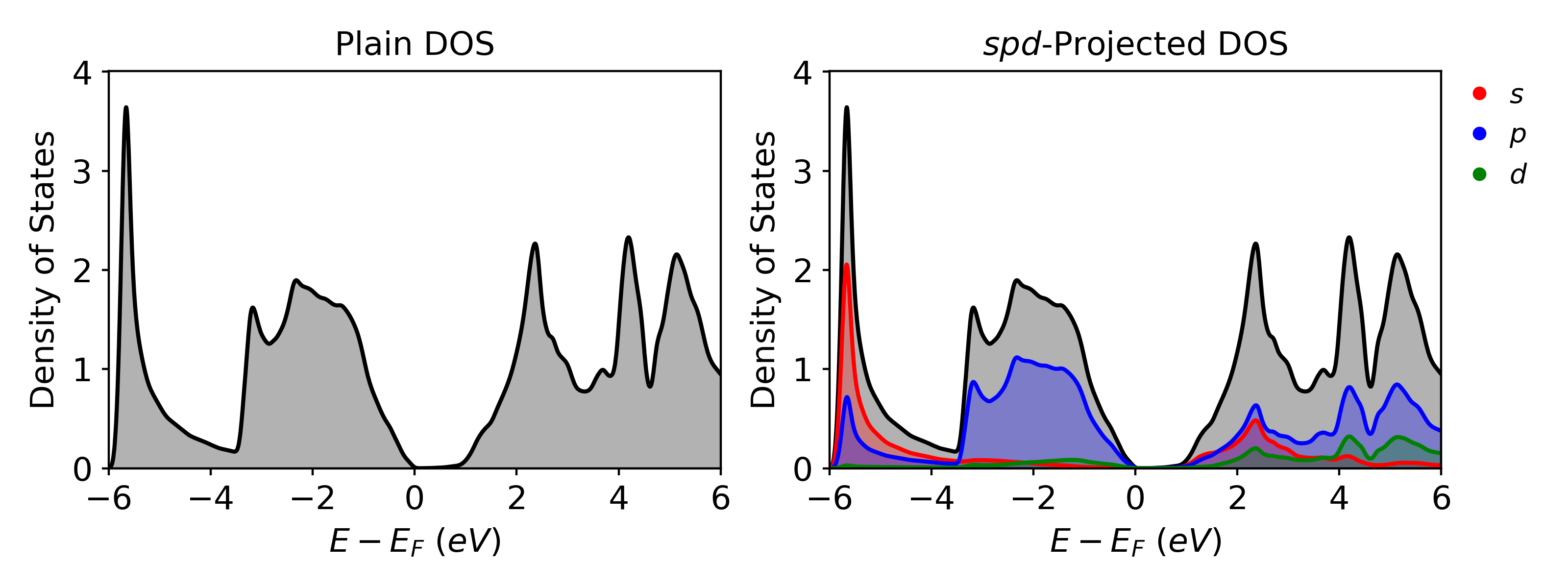
Once the calculation is completed, VaspVis can be used to visualize the density of states plots. The following code shows how to easily generate two DOS plots which will be saved as dos_plain.png and dos_spd.png which are shown below
Band Structure Calculation
After the SCF calculation is finished, the CHG and CHGCAR files can be copied to the folder with the Band calculation files. For a more detailed breakdown of the Band calculation see section Step 3 - Calculation Descriptions.
INCAR
The INCAR for a band structure calculation can be generated using the incar.py file.
Which results in the following file:
# general
ALGO = Fast     # Mixture of Davidson and RMM-DIIS algos
PREC = N        # Normal precision
EDIFF = 1e-5    # Convergence criteria for electronic converge
NELM = 500      # Max number of electronic steps
ENCUT = 400     # Cut off energy
LASPH = True    # Include non-spherical contributions from gradient corrections
NBANDS = 24    # Number of bands to include in the calculation
BMIX = 3        # Mixing parameter for convergence
AMIN = 0.01     # Mixing parameter for convergence
SIGMA = 0.05    # Width of smearing in eV

# parallelization
KPAR = 8        # The number of k-points to be treated in parallel
NCORE = 8        # The number of bands to be treated in parallel

# band
ICHARG = 11     # Calculate eigenvalues from preconverged CHGCAR
ISMEAR = 0      # Fermi smearing
LCHARG = False  # Does not write the CHG* files
LWAVE = False   # Does not write the WAVECAR files (True for unfolding)
LORBIT = 11     # Projected data (lm-decomposed PROCAR)

# soc
LSORBIT = True  # Turn on spin-orbit coupling
MAGMOM = 6*0 # Set the magnetic moment for each atom (3 for each atom)
KPOINTS
For a band structure calculation, the KPOINTS file is the most important input because it determines the path of your band structure. Usually we find the path from literature or helpful tools such as SeeK-path. For our zinc-blende structures such as InAs we choose the k-path \(\Gamma-X-W-L-\Gamma-K\), which can be generated using the following code with kpoints.py.
The resulting KPOINTS file will look like this:
Line_mode KPOINTS file
50
Line_mode
Reciprocal
0.0 0.0 0.0 ! G
0.5 0.0 0.5 ! X

0.5 0.0 0.5 ! X
0.5 0.25 0.75 ! W

0.5 0.25 0.75 ! W
0.5 0.5 0.5 ! L

0.5 0.5 0.5 ! L
0.0 0.0 0.0 ! G

0.0 0.0 0.0 ! G
0.375 0.375 0.75 ! K
Results
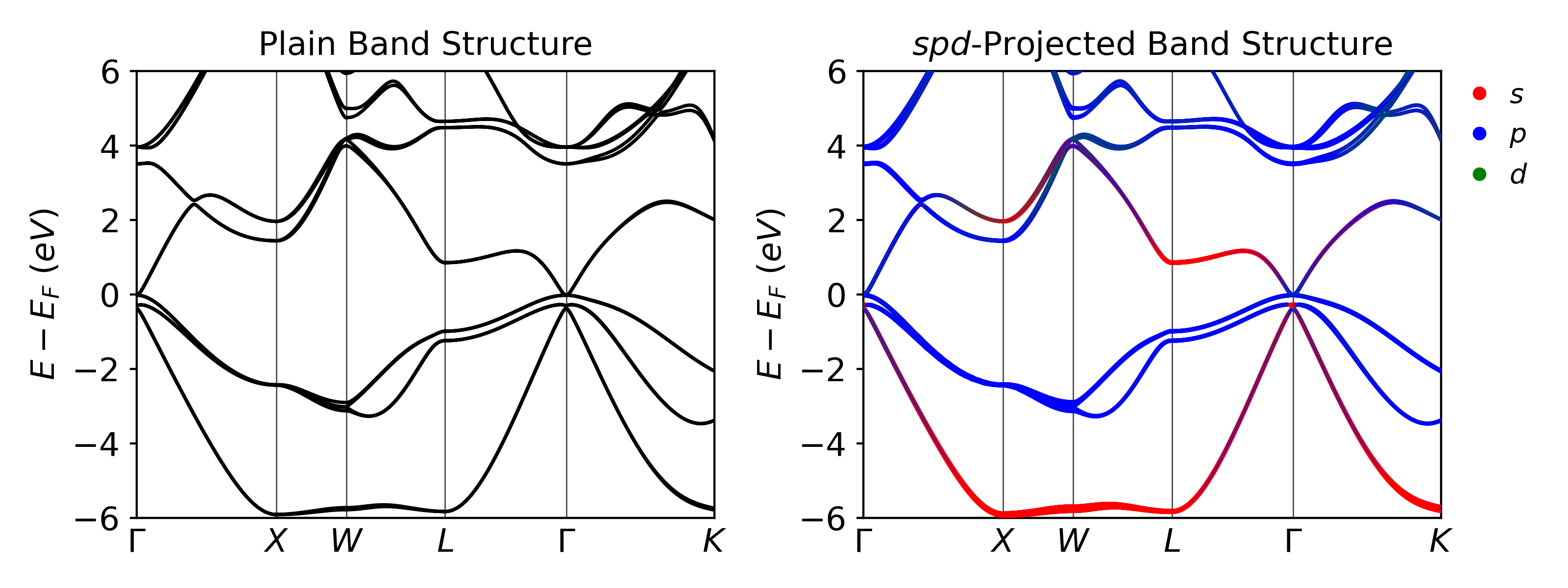
Once the calculation is completed, VaspVis can be used to visualize the band structure plots. The following code shows how to easily generate two band structure plots which will be saved as band_plain.png and band_spd.png which are shown below:
Concluding Notes
Some things to note about the results:
- This calculation was a bit slower than the calculation without PBE. It took about 35 seconds for the SCF calculation, 30 seconds for the band calculation, and 30 seconds for the DOS calculation using 1 node on the NERSC Cori machine.
- PBE+SOC is still predicting InAs to be a metal (no band gap) even though we know from experiments that is it a small band gap semiconductor with a band gap of ~0.35 eV.
- This is a common error for DFT as it underestimates the band gap due to the self interaction error. We will look at ways to fix this this in future calculation.
- SOC can usually increase the size of the band gap, but for small band gap semiconductors, just adding SOC isn’t enough.
Created : 22 janvier 2023